

For most onchain teams, sourcing liquidity providers is the single hardest part of going to market. You can ship a great product, design a sound incentive structure, and still find that the right capital does not show up. The issue rarely lies with the product itself. It lies with how the LPs who would actually fit your protocol find out it exists, and decide it is worth their time.
This guide breaks down what LP sourcing means today, the two architectural models for solving it onchain, and the metrics that separate platforms that broadcast incentives from platforms where LPs actually transact.

What LP sourcing actually means?
LP sourcing is the practice of attracting capital to your protocol by drawing in the right liquidity providers (sometimes called capital allocators in institutional contexts).
Incentives are the standard tool, but sourcing is the broader question of which LPs ever encounter your opportunity in the first place, and why they choose yours over the alternatives. It is not the same thing as incentive design, which decides how rewards are structured, or campaign management, which handles ongoing parameter adjustments after a program is live. Sourcing is the demand-side problem: where do your LPs come from, why do they choose your opportunity over a competing one, and what makes them stay?
In practice, sourcing onchain decomposes into three sub-problems.
- The first is reach: how many LPs ever see the opportunity exists.
- The second is qualification: among those who see it, how many match the capital profile, risk appetite, and asset preferences your protocol needs.
- The third is conversion and retention: among qualified LPs, how many actually deposit, and how many remain after the incentive period ends.
Different sourcing architectures optimize for different points in this funnel.
The two models for sourcing LPs onchain
Two approaches have emerged. They look superficially similar, but they produce very different liquidity profiles.
The network-led model: outreach with a companion app
The network-led model treats LP sourcing as a customer-acquisition problem.
In structure, the platform operates a CRM of liquidity providers: it maintains a database of verified LPs, segmented by capital profile, asset preference, and historical track record. Issuers define their target LP segment, and the platform pushes the opportunity to that segment, often through an advisory layer that helps issuers structure the offer. A network-led platform may also operate a companion marketplace app where LPs can browse opportunities, but the primary mechanism remains the network and the outreach against it.
The strengths of this model are clearer attribution of which LPs were reached, hands-on support for teams without dedicated liquidity strategists, and explicit qualification of LP profiles before outreach.
The limitations are structural: the addressable pool is bounded by the size of the curated network, push-based distribution depends on LP responsiveness to outreach (which in DeFi is structurally low), and the advisory layer introduces incentive misalignment, since advisors are compensated on activity rather than long-term liquidity outcomes.
The marketplace-led model: depth and self-selection
The marketplace-led model frames LP sourcing as a discovery problem.
Issuers list their opportunity on a venue where LPs are already active. LPs filter, compare, and self-select into the opportunities that fit their criteria, including asset, chain, expected APR, lock-up, and counterparty preferences.
The strengths are different in nature. The addressable pool is the entire active onchain LP base that consults the marketplace, not a static contact list. LPs who self-select are higher-intent, because the decision is theirs. Comparability is built in, since multiple opportunities are evaluated side by side. And there is no advisory layer extracting margin between the issuer and the capital.
Why marketplace sourcing produces stickier liquidity
In practice, most platforms today run hybrid versions of these two models. A network-led platform often layers a companion marketplace app on top of its outreach engine. The question is not whether the surface exists, but which is the primary architecture, because that determines the depth of the marketplace LPs actually encounter.
A companion app listing tens of opportunities is not a marketplace in the same sense as one with thousands of opportunities across dozens of chains. Some network-led platforms even populate their own app with opportunities pulled through third-party marketplace APIs.
Beyond surface depth, four structural advantages explain why marketplace-led sourcing tends to produce liquidity that stays.
1. Self-selection signals intent
An LP who searches a marketplace, compares multiple opportunities, and chooses yours has revealed information about themselves. They have decided your APR-to-risk profile fits their strategy. This pre-qualification is impossible to fake, and it correlates strongly with retention. LPs pushed into a position through sourcing outreach tend to exit at the first APR compression, because the original choice was not theirs to begin with.
2. Transparency reduces adverse selection
When opportunities are listed openly with clear parameters, issuers compete on terms LPs can verify. There is no hidden advisor margin, no rebate negotiated behind the scenes, no asymmetric information about who else has been pitched. Markets that are transparent attract participants who want fair pricing, which over time means deeper, longer-lived liquidity.
3. Aggregation creates scale curated networks cannot match
A marketplace that lists every meaningful onchain incentive opportunity becomes the default destination for LPs allocating capital. The flywheel is straightforward: more issuers attract more LPs, and more LPs attract more issuers.
Curated networks compete by adding contacts to a list and by deciding which opportunities are worth surfacing, a gatekeeping function that, by design, narrows what LPs can see and what issuers can reach.
Marketplaces invert this: every legitimate opportunity is listed, and LPs perform the curation themselves through filters, search, and side-by-side comparison. The result is an environment where issuer quality is judged by LPs voting with capital, not by a small team deciding what LPs are allowed to encounter.
4. No advisory bias
Advisory services, however well-intentioned, sit between the issuer and the LP and are paid for that intermediation. That creates a structural pressure to recommend the campaigns that pay the advisor, not necessarily the campaigns that produce the best liquidity outcomes.
A marketplace removes the conflict by aligning the economics directly with the issuer-LP transaction.
How Merkl operates as an LP marketplace
Merkl is the largest LP marketplace onchain, by every measurable indicator of marketplace depth and LP activity.
Depth here is what makes the comparison possible: LPs who land on a marketplace need a critical mass of distinct, parallel opportunities to filter and rank against, and that mass is what separates a working marketplace from a catalogue.
More than 200,000 unique liquidity providers visit the Merkl App every month to compare and select onchain opportunities. At the time of writing, more than 4 million unique LPs have received rewards through the platform since launch, and over $1.6 billion in incentives has been distributed to those LPs. The platform currently processes approximately $541k in daily distribution across approximately 1,000 live opportunities. Merkl's infrastructure spans more than 60 chains, ensuring issuers can reach LPs regardless of where their protocol is deployed.
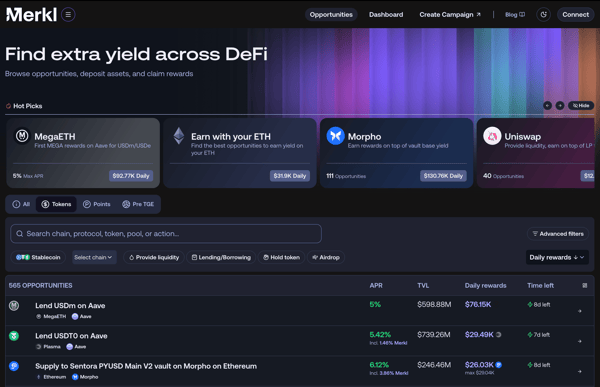
The marketplace surface is not limited to the Merkl app itself. Merkl's API reaches more than 5 million users across DeFi through native integrations with leading frontends, including Coinbase, Morpho, Uniswap, and Aave.
When an issuer lists an incentive opportunity on Merkl, that opportunity is surfaced not only to LPs browsing the Merkl app but also to LPs in the integrated venues where they already manage their positions. The total reach is the union of the Merkl audience and the audiences of every integration partner.
On the supply side, more than 250 companies source LPs through Merkl, including PayPal, Circle, Coinbase, SG-Forge, Kraken, and Morpho. The breadth of issuers means LPs visiting the app see a curated cross-section of the most active onchain incentive programs at any given moment, which is precisely the comparability that makes marketplace sourcing work.
For issuers, the practical sourcing playbook is short. List an incentive opportunity on Merkl, define the targeting parameters (chain, asset, action, lock-up), and the marketplace handles discovery. The 200,000 monthly LPs and the API distribution into Coinbase, Aave, Morpho, and Uniswap do the sourcing work that a network-led platform would attempt with a static contact list, at a scale curated databases cannot replicate.
FAQs
What is the difference between LP sourcing and liquidity mining?
Liquidity mining is one mechanism inside LP sourcing. It refers specifically to issuing token rewards in exchange for capital deposits. Sourcing is the broader question of how the LPs who receive those rewards find your protocol in the first place, and what makes them stay after the rewards stop.
Can a protocol use both a network-led platform and a marketplace?
Yes, and most established protocols do. Network-led platforms can complement marketplace sourcing for very specific high-value LPs, such as institutional desks with bespoke requirements. The marketplace handles the long tail of qualified LPs at scale. Treating the marketplace as the foundation and network-led outreach as a targeted overlay tends to produce the best outcomes.
Is a liquidity advisor better than a marketplace for sourcing LPs?
The two solve different problems. An advisor brings strategic input but sits between the issuer and the LP, with compensation tied to the advisory engagement rather than to long-term liquidity outcomes, which can create misalignment. A marketplace removes the intermediary and lets LPs self-select against transparent terms. The right pattern for most issuers is to treat the marketplace as the sourcing foundation, and bring in advisory only for narrow strategic questions where bespoke modeling adds clear value, typically large protocols running complex multi-chain campaigns.
How do marketplace LPs typically compare to LPs sourced through outreach?
Marketplace LPs generally show higher retention after the incentive period ends, because the original deposit decision was theirs. LPs sourced through outreach tend to be more transactional, exiting positions when better APRs appear elsewhere. Retention data varies by protocol, but the directional pattern is consistent across studies of DeFi liquidity behavior reported on aggregators like Defillama.
What metrics matter when evaluating an LP marketplace?
Three metrics matter most. First, monthly active LPs visiting the marketplace, which measures the addressable pool. Second, cumulative rewards actually distributed to LPs, which measures whether the marketplace moves real capital. Third, the number and quality of issuers, which measures comparability. Listings counts and verified-contact numbers are weaker indicators because they do not measure activity.
Does marketplace-based distribution apply outside DeFi liquidity?
Yes. The same architecture supports dividend distribution on tokenized shares, coupons on tokenized bonds, and yield routing on tokenized funds. See How to Distribute Dividends Onchain for a concrete walkthrough for a concrete walkthrough of how onchain distribution infrastructure handles these traditional finance use cases.